Scripted Compilations: How to Build Faceless Videos From Licensed Footage Without the Copyright Panic
The question somebody messages me at one in the morning
Near one in the morning, a message. The channel is open, the buttons are all understood, the editing software is installed. And the person is stuck in exactly one place: they have no idea where the raw material is supposed to come from. Then comes the question I think a lot of people carry around without ever typing it out loud.
Is making a compilation stealing? Am I going to wake up tomorrow with a copyright strike and monetization switched off?
That question has teeth, because it lands on the biggest fear a faceless creator has. You pour months into something, and then one morning the channel is wearing a label that says inauthentic content, and all of it is gone.
Here is the answer I gave then and the answer I will give you now. The way out is not finding a better video to take. The way out is a different production model entirely, and I am going to spend this article laying it out: what it is, where the legal line sits, the four steps that build one from nothing, and the three ways beginners slide off the line without noticing.
What a scripted compilation actually is
Call it a scripted compilation. Some people call it semi-original content, which is clumsy but honest: half the material comes from somewhere else, half of it is built by you.
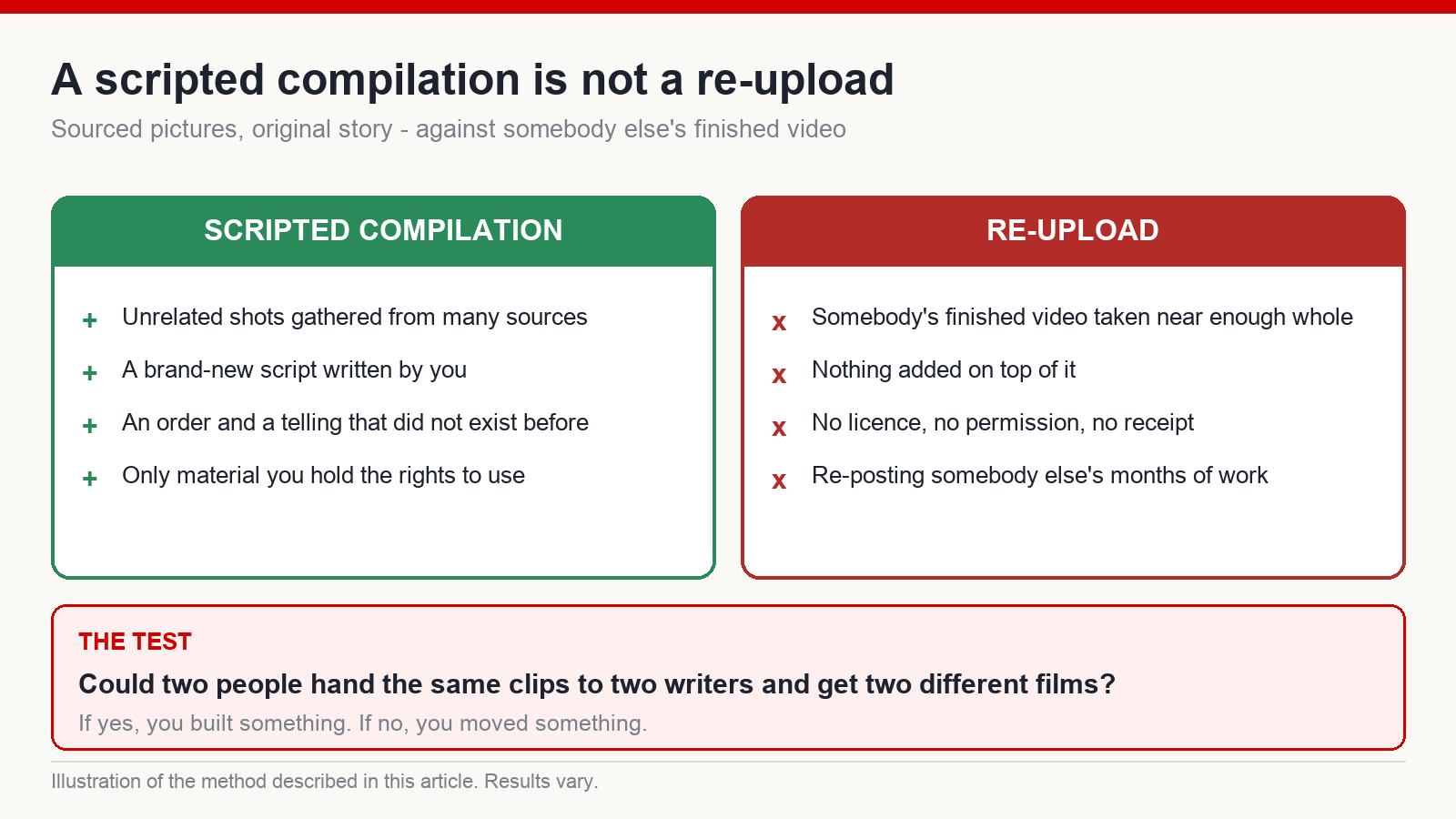
Here is the whole thing in one sentence. You gather unrelated pieces of footage from many different sources, and then you write a brand-new script that turns them into one story. The pictures are sourced. The story is yours.
Put that next to a re-upload and the two roads separate immediately. A re-upload is taking somebody’s finished video, near enough whole, and putting it on your channel. That is a violation and there is nothing to discuss. A scripted compilation buys or licenses the visual material, but the part that matters – which shot, in which order, told which way – never existed until you made it. You are not moving a finished product from one shelf to another. You are assembling something that was not in the world an hour ago.
And this is why I keep pushing people to do it properly rather than fast. A video that a human sat and thought about, that a human hand arranged, tends to survive longer than the videos being extruded a hundred a day by a pipeline with nobody inside it. It is harder for a system to file under inauthentic content, for the plain reason that there genuinely is a person behind it, telling a story on purpose.
You are not picking up other people’s things. You are making something new out of parts you paid for.
Where the copyright line sits: two legs, and you need both
The definition is tidy, but I know the real question sitting in your head is not “what is this called”. It is “am I going to get struck for it”. So let me be blunt enough that you can sleep tonight.
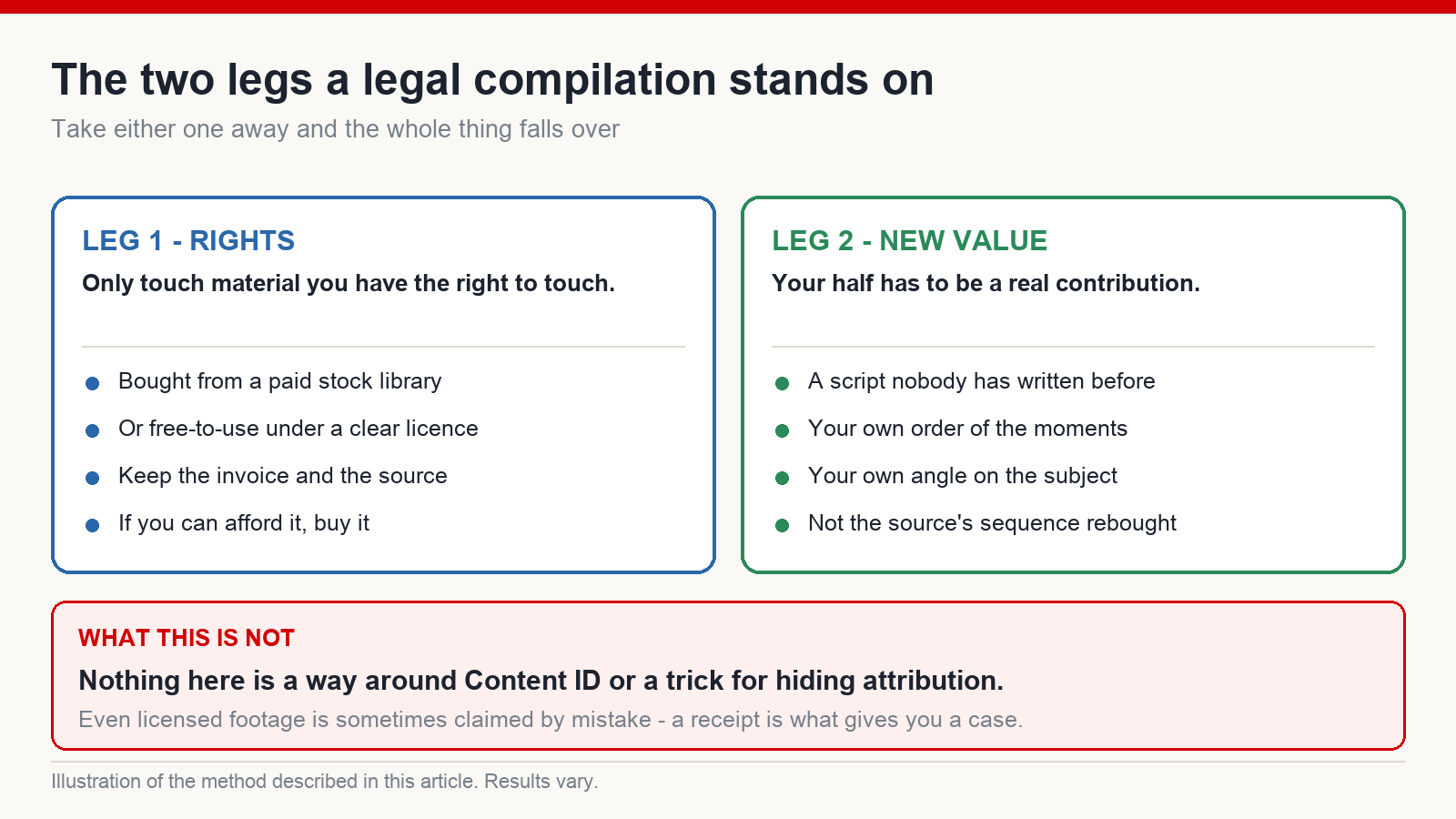
Leg one: only touch material you have the right to touch. Do not scrape whatever is lying around. Clean footage is genuinely easy to get now – Storyblocks and Envato are the two paid libraries I point people at, and Pexels carries a lot of material that is free to use under its licence. My rule is four words long: if you can afford it, buy it. A monthly stock subscription against a channel you have been building night after night is the cheapest insurance in this business.
Respecting somebody else’s copyright is not fear management. It is how you build the habit that eventually protects your own work.
Leg two: your half has to be real added value. A new script. A new way of telling it. An order nobody has put those moments in before. If you buy footage and then lay it out in the same sequence the source had, you are holding a receipt and you still have not made anything – you have produced a more expensive copy.
And so there is no confusion: this article does not teach you to dodge Content ID, does not teach you to strip attribution, does not teach any workaround. Those roads are short, and they end at a dead channel. I am walking the long one, so I do not take those turns.
One more thing I owe you honestly. Even properly licensed footage sometimes gets claimed by mistake. Nobody can promise you absolute safety and you should distrust anyone who does. What changes is your position when it happens: with an invoice, a documented source and a clear creative contribution of your own, you have a case and a route to dispute it. If the material was scraped, you have nothing at all to say.
The four-step framework for building one from zero
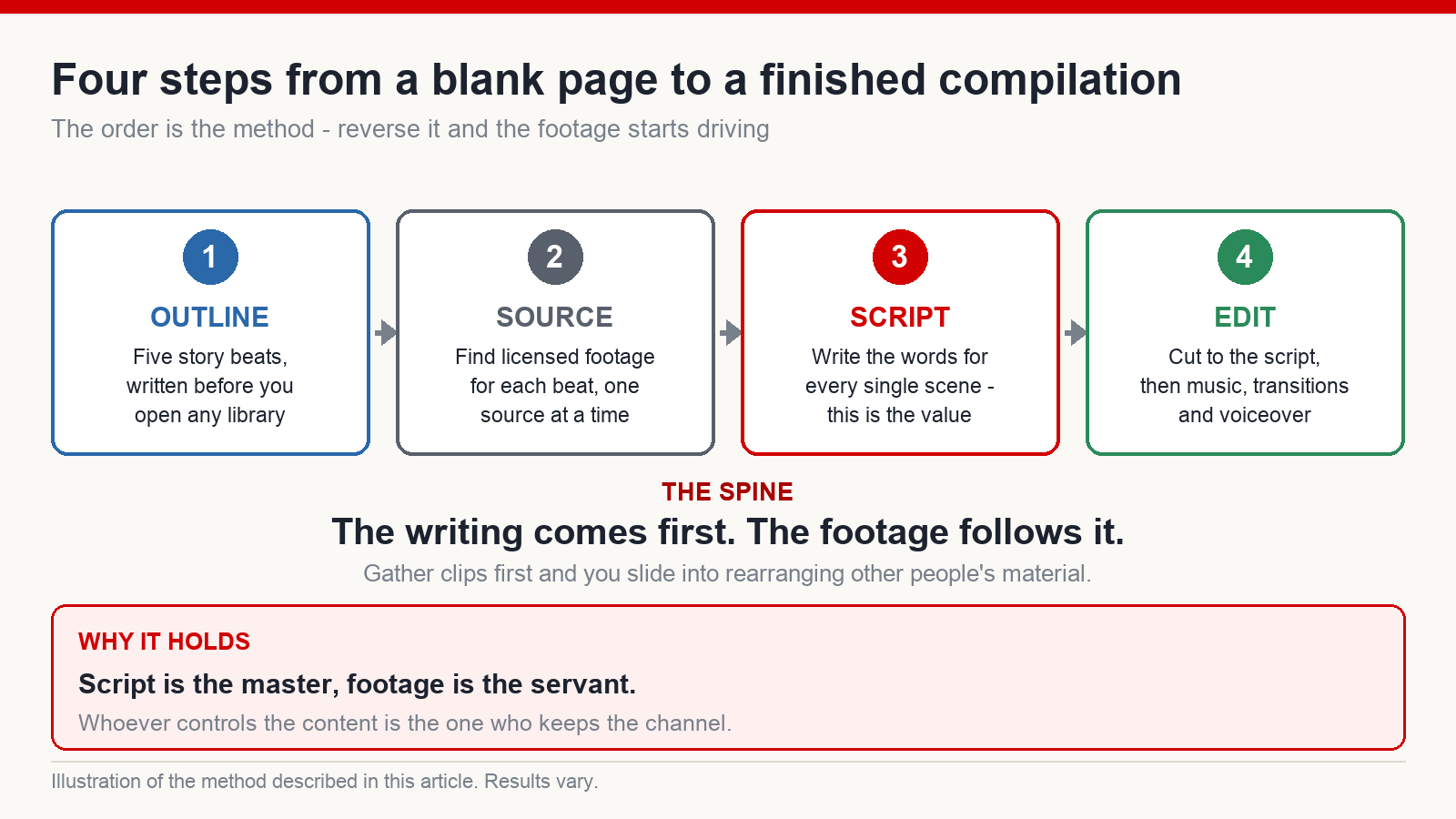
You understand the line now, so let us get to work. A scripted compilation is not a scavenging exercise. It has a four-step frame you can run again and again, and it works whoever you are. I will walk through it with one example so it stays concrete: a video about lions.
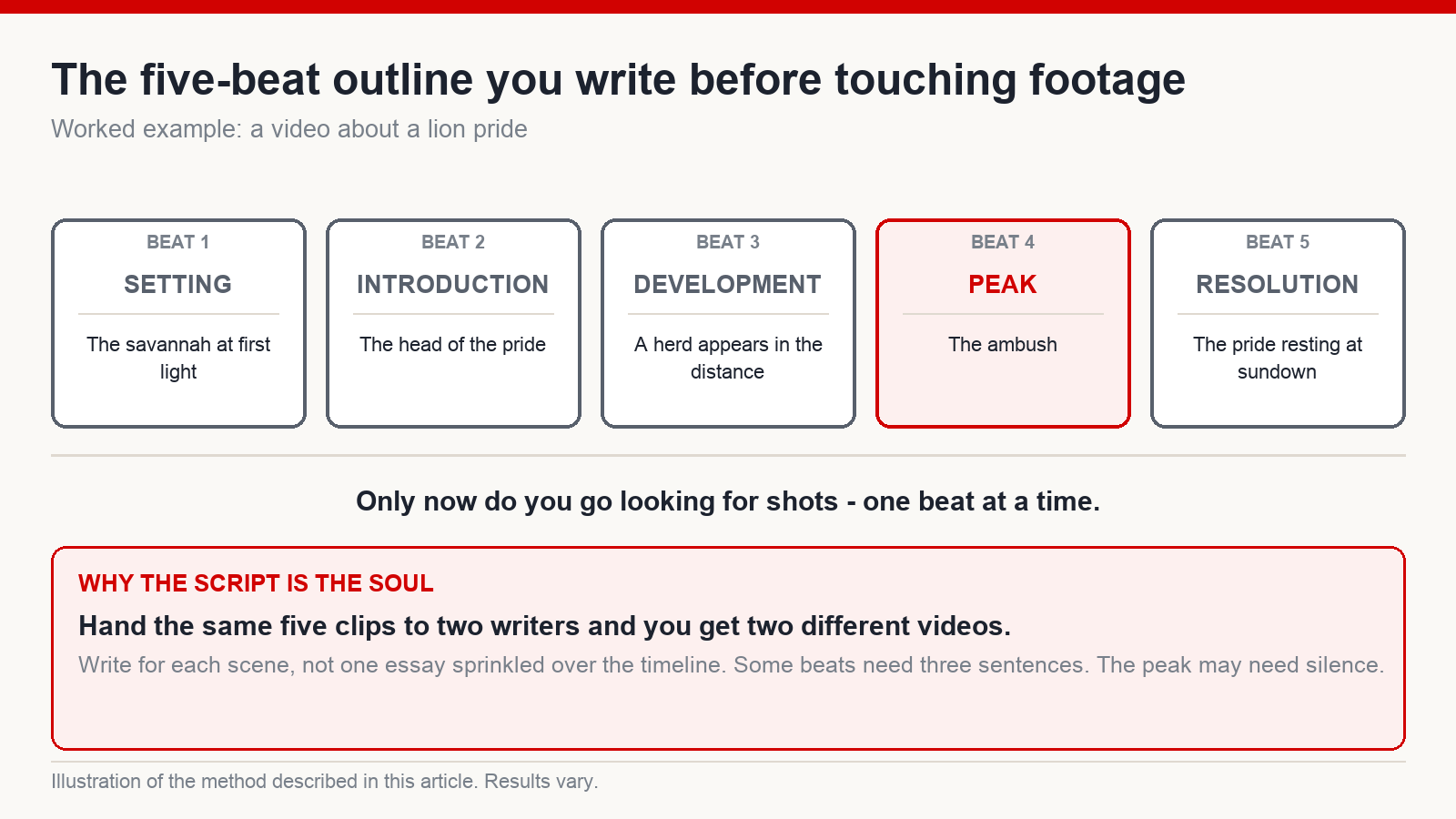
Step one – write an outline of about five beats. Before you open a single stock library, you sit down and write the story arc: setting, introduction, development, peak, resolution. For the lion video: the savannah at first light; the head of the pride introduced; a herd of antelope appearing in the distance; the ambush; the pride resting under a tree as the sun goes down. Those five beats are the frame you hang everything else on.
Step two – find footage for each beat. Now you go looking for pictures, beat by beat. And you hold the copyright rule tight: only material you have the right to use, bought or licensed, from libraries like Storyblocks, Envato or Pexels. This is the stage where you are pulling shots from many places, each scene from a different source, so that in a minute you can assemble a story that belongs to you.
Step three – write the new script. With the outline set and the footage in hand, you write the words for each scene. This is where the real value gets created, and it is the thing that separates your video from a re-upload. Tell that lion story in your voice, from your angle. Somebody handed the identical pile of clips would not arrive anywhere near your video.
Step four – edit. Only now do you cut: assemble the footage against the script, add music, transitions, voiceover.
And here is the spine of the whole method, the sentence I want you to keep: the writing comes first and the footage follows it. Never gather a pile of clips and then sit there working out what you could say over them. Do it that way and the footage leads you around by the nose, and nine times in ten you slide down into being a person who rearranges other people’s things. When the script goes first, you are driving. Footage is just material you summon to serve a story that already exists in your head. Whoever controls the content keeps the channel.
Step three deserves its own section: writing a script worth watching
Those four steps sound compact, but one of them decides whether your video is worth something or worth nothing, and that is step three. It deserves a proper stop.
I have a line I use with the creators I work with that sounds strange the first time. A script worth having is one that tells the story without appearing to tell it. Meaning: you do not stand there narrating flatly – “this is a leopard, it is hunting”. You build a moment instead. You let the viewer watch the leopard hold its breath in the tall grass, the muscles loading before the burst. The words carry the feeling forward; they do not read out what the eye has already seen.
That quality lives in rhythm. Short sentences against long ones. Somewhere that piles up. Somewhere that rests. A three-word sentence in the right place outweighs a whole ornate paragraph. Then you use specific numbers: not “very fast” but “fifty-five miles an hour inside three seconds”. Numbers give a story bones. People believe bones.
And here is the part most people skip: you write for each individual scene, each individual clip. You do not write one general essay and sprinkle it over the timeline. Every piece of footage is a breath in the story, so the words for it have to fit to the second. Three sentences over this shot. One over that one. The peak might need nothing but silence and wind.
One practical note, because I know a lot of people use synthetic voices on faceless channels. Do not make the machine perform your delivery – it cannot land emphasis the way a person does. Do the reverse: write the way the machine will read. Break sentences where it can break them. Choose words it pronounces cleanly. You design the writing for the tool instead of forcing the tool to act the writing. It sounds like a concession. It is actually you taking the wheel.
Why do I call the script the soul of the video? Because you cannot analyse a subject you do not understand, and without analysis you cannot do this job at all. The script is where that understanding turns into visible words. It is also the wall the machines have the hardest time climbing: software can assemble pictures, but deciding what to tell, what to cut and where to press is still yours.
Why a human-built compilation outlasts a fully AI-generated one
By now you can probably see why I keep hammering on the phrase “there is a person in there”. It runs straight into your biggest fear.
You are afraid of opening the channel one morning and finding the words inauthentic content on the screen. Months of work, monetization gone between one breath and the next. That fear is legitimate and I am not going to talk you out of it.
But look at it carefully with me. Videos produced by an AI pipeline at volume – dozens a day, one template, one synthetic voice, footage dropped in to fill the frame – are exactly the thing a detection system is built to catch. Because they are hollow. There is nobody inside them.
When you gather real material from many places, write your own script and arrange the story yourself, there is a mind analysing and narrating inside that video. That is much harder to file as inauthentic.
That is why a lot of teams have quietly walked back from fully AI production and returned to scripted compilations. Not because it is some magic life raft. Because they got a fright and realised the thing they had been pouring sweat into was resting on nothing.
Now the sentence I would rather you remembered than any other in this article. What survives is decided by quality, in the end – not by which camp you joined. Pick the right method and write shallow content on top of it and you will still go down. There is no shortcut hiding in here.
A scripted compilation is not a promise of money. It just hands you more doors through which you can reach quality. The rest is on you, and I think that is good news rather than bad.
Three traps that quietly turn a scripted compilation into a re-upload
You know what right looks like, so now let me show you what wrong looks like – because the line between the two is thinner than you think. Nobody wakes up and decides to steal. People slide across, one harmless-seeming decision at a time. These are the three I see beginners fall into most.
Trap one: gathering footage first and thinking about content afterwards. It sounds reasonable, which is what makes it dangerous. You scroll past a few beautiful shots, download a pile, and then sit down to work out how to build a video out of them. But when the footage is leading you, you have stopped telling your story – you are threading other people’s things together. That is the exact moment a scripted compilation quietly becomes a re-upload. Remember the spine: writing first, footage second. Script is the master, footage is the servant. Reverse them and you lose control at step one.
Trap two: taking free footage of unknown origin to save money. I understand it. Stock costs money and when you are starting out every payment hurts. But the principle has to hold: if you can afford it, buy it, and only use material you genuinely have the right to use. That clip you casually pulled off some unfamiliar channel, no licence, no traceable origin, is a timer quietly counting down. One copyright strike is enough to take down monetization on a channel you spent months building. Respecting somebody else’s rights is not only decency – it is how you keep your own work.
Trap three: writing a lazy script and letting a synthetic voice read it out. This is the subtle one, because from the outside it looks like doing it right. You bought footage. You assembled it. You added narration. But if the script is a few flavourless descriptive lines – no rhythm, no specifics, none of that telling-without-telling quality – you have not created any new value. No new value means your video is still a copy with a fresh coat of paint. A script worth having is the thing that keeps you on the right side of the line.
Look closely and those three traps are the same three links I taught you above, seen from the back.
Where to start when you have nothing in hand
Back to the person messaging at one in the morning. Their fear is your fear: the channel is open, the buttons are learned, and you are frozen because you do not know where to get content from safely.
So, plainly. The way out is not hunting down a good video to take. It is gathering material you have the right to use and writing a script that belongs to you.
And the first step is far smaller than you expect. Do not open a stock library yet. Do not worry about copyright yet. Today, just pick one subject you actually understand – something you could talk a friend through without looking anything up. Then open a blank page and write the five beats: setting, introduction, development, peak, resolution. Content first. Footage later.
Why start with your head rather than a folder of clips? Because you have to understand a subject before you can analyse it, and without analysis this job does not work. The script is where you create the new value – the part that is hardest to imitate, the part that stops your video being a copy of anybody.
Write those five beats and the road tends to show itself. I am not speculating. I started from exactly that blank page.
Do not go and take other people’s things. Go and retell the world in your own voice.
Will YouTube hit a compilation video with copyright strikes?
If you use footage you have the right to use – bought from a stock library, or licensed material from a free source – and you write your own new script over it, the risk is considerably lower than a re-upload. But honestly: nothing is absolute, and correctly licensed material does occasionally get claimed by mistake. The difference is that with an invoice and a real creative contribution you have grounds to dispute it and get it back.
What is the actual difference between a scripted compilation and a re-upload?
A re-upload takes somebody’s finished video near enough whole and posts it on your channel. That is a violation. A scripted compilation gathers unrelated footage from multiple sources you are licensed to use, and you write a new script that turns them into a story that did not exist before. One is copying. The other is building.
I am new and cannot afford stock footage yet. Where do I start?
Start with your head, not your wallet. Today all you need to do is choose a subject you understand and write a five-beat outline. Sourcing comes later. Free-to-use libraries exist so you can practise the craft before you spend anything.
Is it a problem to use a synthetic voice on a faceless channel?
No, plenty of channels do. The trick is to write for the way the machine reads – break sentences where it can break them, choose words it pronounces cleanly – rather than forcing it to perform your delivery.
How long should a compilation be?
Long enough to finish the five beats and no longer. Length is an output of the story, not a target you pad towards. If the peak arrives at six minutes, the video is six minutes.
A note on method: everything above is how I work and how I teach, not a published platform standard. I am not promising views or income, and no article can. Copyright rules and platform policies also change, so treat this as a starting frame and check the current policy yourself before you publish.
Written by Phuc, a YouTube trainer who has been building on the platform since 2017 – nine years – working mainly on faceless channels aimed at English-speaking audiences.
The full step-by-step system I run with the creators I work with lives at mmoyoutube.com.